Showing posts with label Raleigh. Show all posts

Monday, March 1, 2010

Update regarding AIANC Center for Architecture and Design


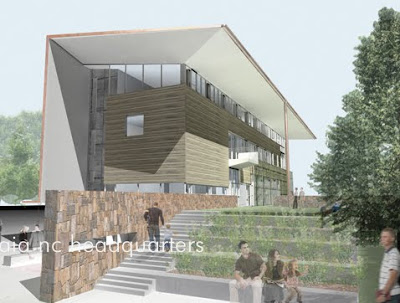
Ever since Frank Harmon won the competition for the AIANC Center for Architecture and Design in January 2008, not much had been made public about how the project was progressing. Even some of our sources close to the project seemed skeptical that the project would be built soon. Given the current state of the field and economy in general, it would have been understandable if the AIA had decided to put the project on hold. It might not have sent a positive message to its members, but understandable nevertheless.

Fortunately for us, that's not the case. Two weeks ago, in the annual Harwell Hamilton Harris Lecture, Frank Harmon showed images of the project (located on the corner of Peace and Wilmington at the end of Raleigh's government mall) after several years of design development with a large committee of designers. He went on to describe his "healthy urbanism" project in careful detail, including the original design concept, developments since the competition and a fairly thorough discussion of the building's intended purpose and sustainable features. He announced furthermore, that construction by Clancy & Theys should begin this May and that the building should be completed within 10 months.

We here at Raleigh Art, Architecture and Urbanism are excited to hear that this project is on track to be built so soon. More information has been released: a fairly thorough project booklet on AIA NC's website including plans, sections, materials, sustainable systems, salient diagrams, and cost estimates, and more information from WUNC's the State of Things (follow the link to listen to the audio) last Friday. Frank, Along with Scott Cutler of Clancy & Theys joined Laura Leslie to talk about the project's status.

We applaud AIA NC for pushing this project forward despite tough economic times, setting an example of responsible design not only in the Triangle or the State, but nationally as well. According to the audio North Carolina AIA will be the first chapter to design and construct their own building. If that's true, (we haven't had the chance to verify this so don't hold us to it), what does that say about the AIA itself? How could such a large professional body, which specializes in designing buildings, not have ever designed their own headquarters? This project has the opportunity to not only be a model for sustainable design, but also a center for outreach. All signs seem to point to the fact it will be a place for people to visit, hold activities and meetings, and most of all to open minds about the impact design has on our day to day lives and how truly important good design can be for our future.

Sunday, January 3, 2010

Raleigh's little-known connection to Make It Right

While Cherokee’s history is fairly well-known in Raleigh, (primarily in development circles), the firm’s connection to the nationally recognized Make it Right foundation is not.

I recently had the good fortune to tour the offices of Cherokee on 111 East Hargett Street in downtown Raleigh. The opportunity arose through a personal contact, who, until the recent economic downturn, had been heavily involved with Cherokee’s non-profit arm, Cherokee Gives Back. It began with a simple conversation several months ago when my friend became pleasantly surprised by my interest in Cherokee and their brownfield redevelopment efforts. I had come to know Cherokee while studying urban planning several years ago, when the firm was being touted by a professor as one of the “good guys” in the development world. (I continue to hold the same opinion after coming to know the firm at a much more intimate level.)

A brief pause in the story to give a history of Cherokee and it’s development to become a cutting-edge, sustainable development firm. From Cherokee’s website:

In 1984, a group of investors including Tom Darden purchased four brick plants and merged them to form Cherokee Sanford Group (CSG), which grew to become the largest privately held brick manufacturer in North America. When we discovered petroleum-contaminated soil at one of the plant sites, the regulators suggested taking the impaired soil to a nearby landfill. As an alternative, CSG proposed mixing it with clean clay in the brick-making process. The combustion in the kilns burned up the fuel oil in the soil. From this beginning, CSG started a business of receiving contaminated clay from underground storage tank clean-ups. By 1990, CSG was the largest soil remediator in the mid-Atlantic region, eventually cleaning up nearly 15 million tons of contaminated material.

Tom Darden and John Mazzarino formed the predecessor company of Cherokee in 1993 to focus exclusively on environmentally impaired assets. In 1994 they organized a risk management advisory affiliate and then formed Cherokee's first institutional capital (Fund I) in 1996. Cherokee formed a $250 million private equity fund (Fund II) in 1998, a $620 million fund (Fund III) in 2002, and its current, $1.2 billion fund (Fund IV) in 2005.

Elsewhere on the firm’s website it states that the capital has now grown to nearly $2 billion under management in Fund IV. Make no mistake that Cherokee is in business to make a profit for their investors, but unlike many other developers, they are seeking to achieve that goal by developing sustainable properties, often on formerly contaminated soil.

Initial discussions with my friend gave way, to more serious, sit-down discussions about his previous role with Cherokee. Eventually he loaned me the book Architecture in Times of Need – Make It Right Rebuilding New Orleans Lower Ninth Ward. I read the entire book that day and learned that my friend, Samuel Whitt, was involved with Cherokee Gives Back such that he is currently the only board member of the Make It Right Foundation, although he later told me that they have one board member confirmed to soon join and several others in various stages of discussions.

After one of our discussions, Sam took me on a tour of Cherokee’s Offices in downtown Raleigh, where I met John Mazzarino and Tom Darden, both of whom were friendly and engaging. The real reason for the office visit was to show me Cherokees offices, where they retrofit (in conjunction with property owner Empire Hardhat), a 100 year old furniture store into one of the few Leed Platinum renovation projects in the US. The AIA wrote a fantastically detailed article about the renovation if you follow the link, so there is no need for me to go into detail, but please take a look. The project is very interesting and highlights many of the challenges posed when trying to upfit an old structure into a “green” office building.

Finally, the connection between Cherokee Gives Back and Make It Right goes all the way to the beginnings of MIR. I don’t know all the details, (although they can be found in the book which I referenced earlier), but my understanding is that sometime between late 2006 and early 2007, Tom Darden (CEO Cherokee), Samuel Whitt, William McDonough and others met with Brad Pitt to discuss his ideas to help out the residents of the Lower Ninth Ward in New Orleans. This was in response to Pitt’s widely publicized criticisms of the Federal Government’s slow response to help the residents of New Orleans. More detailed information about the mission and history of MIR can be at Make It Right.org.

Personal opinions vary widely on the success of the Make It Right Foundation. However, when many were sitting on their hands, they came in, and through donations, have almost met the original goal of 150 houses and continue to make home ownership (specifically for residents returning to rebuild in the Lower Ninth Ward) a viable option. I recognize that many of the houses are non-traditional, some seem too theoretical or idealistic, but in the end they will be safer, healthier (and hopefully) more affordable houses for the families living in them. More information about the goals for the houses and the homeowner process can again be found on MIR’s website.

This article was not so much about determining the values and successes of the Make It Right Foundation, so much as it was intended to publicize the crucial role that a local firm, Cherokee, played in helping get MIR up and running. Cherokee, through Cherokee Gives Back provided the manhours and expertise to get the ball rolling, by working with Brad Pitt and William McDonough + Partners among many others, including many New Orleans residents. Cherokee also provided the critical institutional infrastructure when the foundation was formed, donations began to roll in and administrative functions were needed. Very quietly, and from hundreds of miles away, a Raleigh firm played a big role in getting what has become a very nationally recognized foundation off the ground. And that’s just one aspect of what Cherokee Gives Back has been busy doing over the past few years.
Monday, August 3, 2009

New House Tour Offerings by Triangle Modernist Houses

Triangle Modernist Houses just opened sales for three tours this fall in Raleigh and Durham. The last tour sold out very quickly, so if you are interested you better sign up quickly.

From the TMH website:

Saturday, August 15, 10-1130 : Pullen Memorial Chapel in Raleigh, $5.95

Saturday, October 3, 1-3, Michael Coates Residence Durham, $5.95

Saturday, November 7, 1-4, Architects' Homes: Thomas Crowder, Brian Shawcroft and Raymond Sawyer, $9.95

Sunday, August 2, 2009

Sense of Arrival in Raleigh

When defining a city, the sense of arrival is crucial, not only does it signify the arrival itself but it defines the boundaries of a city. The first impression plays a significant role in shaping our opinions of each city as a place and helps to inform us about its identity. This is an analysis of the sense of arrival into downtown Raleigh from the southeast. (McDowell Street / NC Hwy 50).

The McDowell St. corridor offers us the signature view of the Raleigh skyline. While different than that from the Boylan bridge, it is unquestionably one of the City's best. The road, while busy, seems more like a parkway than a highway with it's winding path and well landscaped median. In the distance a city of Raleigh sign marks the arrival.

A wooded threshold clearly delineates the urban core boundary, rather than letting the development spill out. In many cities this threshold is a veritable no man's land, often heavily littered and marking a poor entry to downtown. The entry to Raleigh's urban core is well-maintained and deliberately designed to heighten the experience.

The Convention Center sits prominently at the crest of the hill and through it's placement, strongly anchors the southeast corner of downtown Raleigh. Designer's clearly understood the meaning of the site when planning for the convention center, the corner detail appropriately addresses the corner condition.

The "shimmer wall" on the west side of the convention center provides a positive face to the street. The building serves as both an iconic structure, which is well worth visiting, as well as the face of "New" Raleigh and therefore allows for a sense of intrigue among visitors, which every city needs.

Street trees and furniture serve as amenities in the pedestrian environment. While enhancing both beauty and safety they also significantly increase the walkability of downtown.

The vacant lot immediately west of the convention center, for which the city is generating plans for a park and outdoor amphitheater among other things. In the distance, the south side of a new Wake County public parking garage. This elevation, primarily clad in a brick veneer, cleverly disguises the fact that this is a parking garage, which is done successfully throughout the city. The perforations allow for natural ventilation through the garage, but also form an engaging facade to the street. This has got to be one of the best looking parking garage elevations around.

The east elevation is not nearly as successful as the southern elevation. Hopefully, there are future plans for some sort of cladding, or future development of this elevation. What I don't understand is why this elevation isn't designed similarly to the southern side of the building, allowing natural ventilation to pass through the entire structure. Where the southern elevation successfully addresses the street, this drab concrete wall acts as a black eye to what is otherwise a successful entrance to the city on the east side, as well as the north side.

If a street wall were a smile, the entrance into Raleigh is missing a few teeth. The undeveloped lot west of the convention center is unattractive, but hopefully that will soon be remedied. The underutilized Enterprise rental car office and adjacent enormous surface parking lot will need to be addressed, sooner rather than later. The east side of the public parking garage needs further development. However, what is in place is solid and provides a good foundation for future growth.

Overall Raleigh's downtown is clearly undergoing a major renaissance. Major changes are taking place, many for the good, which will be covered in future posts. The central business district is fairly well delineated and dense growth seems to be contained in the urban core. Clearly the triangle region as a whole is very decentralized, which is a major issue, but this is regarding the density immediately in and around downtown. Urban densities don't yet seem to be encroaching on residential neighborhoods. This isn't to say that all of neighborhoods adjacent to downtown are thriving because they aren't. However, the downtown is fairly well contained, meaning there isn't the typical ring of medium density commercial and industrial uses around the city, uncomfortably integrating with nearby urban neighborhoods. In Raleigh, a fairly distinct threshold delineates the urban core and nearby neighborhoods as distinct and congruous entities.

This entrance into the Capital City promises to have a bright future. The city has done its part in building the foundation, and setting the standard for further development of this important corridor into Raleigh.

Saturday, July 25, 2009

N & O Home of the Month

The News and Observer's July edition of the "Home of the Month" was released today. The "Home of the Month" is a collaborative initiative between N & O, and NCSU's College of Design, specifically through the Home Environments Design Initiative (HEDI). This month's article is written by recent NCSU graduate Sarah Corbitt.

The house was designed by Brett Hautop who is a principal at Vernacular Studio and also an NCSU College of Design graduate. Vernacular Studio is located at 530 Hillsborough Street in Raleigh.

The 3,600 square foot Modern Victorian sits prominently on a hill just outside of downtown Raleigh, near historic Oakwood.

Saturday, July 11, 2009

What could this be?

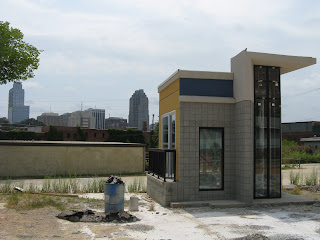
So I am heading downtown to Boylan Avenue and I happen upon this structure which is curiously all by itself in a field next to what appears to be an abandoned manufacturing facility.


Curious as always, I stop for a minute to inspect what it might be. Truthfully, I had no idea. My first thought was that it could be some kind of installation. My wife suggested that it might have some sort of relation to the nearby train tracks, maybe a conductor's office for example. After a few minutes, we had no idea so we got back in the car and continued on our way.

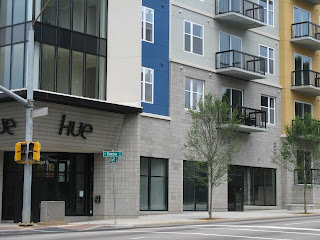
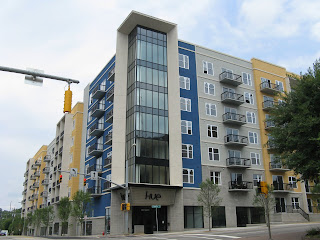
A short time later, I'm driving, still thinking about what the structure may have been and I notice a building that seems oddly familiar. It's the new Hue Condominium project. But why does look so familiar? Then it hits me, the small structure that we saw a few blocks back must be some sort of trial run or teaching tool for the contractors who would be installing the exterior of the building. By using the same materials and detailing, a small detail (or a very large study model) was likely as practice before finishing the actual project.

You'll notice the exact same materials and detailing used in both structures. The same color palette too. As for the project itself, I think the location is perfect for a mixed use building. The design is fairly interesting, but to me something seems to be lacking. However, I am all for the concept of urban living and mixed-use developments. Hopefully all the condos sell, but in my amateurish opinion, it seems like Raleigh's downtown is over-priced and over-built given the current housing market. I always want downtown developments to succeed to continue fueling the urban renaissance that taking place all across the country, of which downtown Raleigh is an excellent case study.