Showing posts with label Frank Harmon. Show all posts

Friday, January 7, 2011

Recent Visit to Prairie Ridge Ecostation

A recent visit to Prairie Ridge Ecostation opened my eyes to how much is going on there. The 45 acres of prime Piedmont landscape, trapped on an island between several major thoroughfares including I-440, and Wade Avenue as it merges with I - 40, is a protected natural oasis amidst the transportation bustle of West Raleigh.
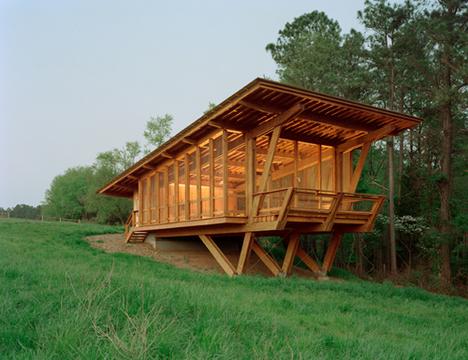
Prairie Ridge Outdoor Classroom - Treehugger.com

Hemmed in by state-owned buildings and continued development, visitors have access to several eco-friendly structures, prairie, forest and a stream - typical features of the Piedmont Region. Accessed from Edwards Mill or Blue Ridge roads, Prairie Ridge is part of North Carolina's Museum of Natural Science's mission to "enhancing public understanding and appreciation of the natural environment while acting as a model for renewable and sustainable energy."

Surprised as I was to see all the effort that has been put into raising awareness and instructing about sustainable living, I was shocked to learn that an even bolder plan is being envisioned for the future. An overnight facility is being designed to allow visitors the first-hand experience of what it means to live a sustainable lifestyle in the Piedmont, by Frank Harmon's office known as the Prairie Ridge Eco-Lodge. Harmon's office also designed the outdoor classroom, featured in Architectural Record in November 2006. They also provide opportunities for education for visitors of all ages, and other "green" events.

The staff was friendly, and knowledgeable about both the design of the structures as well as the ecology of the natural environment. They shared with us that an upcoming meeting will determine if funding is in place for the Eco-Lodge to be built. Specifics about the meeting will be posted when we find out more information.

If you haven't been out to Prairie Ridge, or just haven't been in awhile, stop by (hours) and someone will be happy to show you around, or take the self-guided tour - either way, it's worth your time.


Thursday, May 13, 2010

Triangle Firm Increases National Recognition

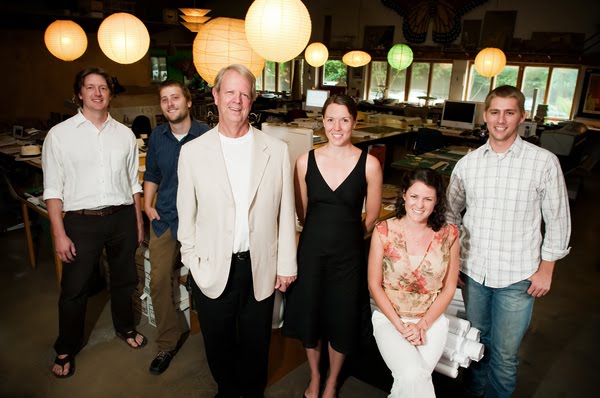
Frank Harmon Architect PA continues to gain national recognition, this time appearing at number 13 on Architect Magazine's top 50, up from 26th last year. Congratulations to Frank Harmon and his staff for their efforts.


image from frankharmon.com 5/13/2010


From Frank Harmon Architect PA facebook page:

May 12, 2010 (RALEIGH, NC) – Frank Harmon Architect PA, a multi-award-winning firm based in Raleigh, NC and recognized nationally as a leader in innovative, modern, and regionally inspired “green” architecture, has placed 13th on Architect magazine’s 2010 list of the top firms in the nation, moving up from the 26th spot the firm held last year.

Frank Harmon Architect PA, founded by principal Frank Harmon, FAIA, in 1985, is the only firm in North Carolina to make the “Architect 50” this year. The Freelon Group in Durham placed 60th and Little in Charlotte placed 71st.

Unlike many other “top firms” lists, the “Architect 50” emphasizes ecological commitment and design quality as much as profitability as the editors determine the country’s very best firms. In fact, many firms ranking far lower than Harmon’s report revenues in the multiple millions.

Senior editor Amanda Kolson Hurley also notes, “Some commercially focused firms that were prominent last year have dropped off the list; conversely, this year’s biggest upward movers tend to be those with a bedrock of public-sector and infrastructural projects.”

Harmon’s firm has been working on and completing several “green” public-sector projects since the 2009 Architect 50, most of modest size and budget. They include Visitors Education Centers at Walnut Creek Urban Wetlands Park in Raleigh, the North Carolina Botanical Garden at UNC-Chapel Hill, Merchants Millpond State Park (recently featured in Architect magazine), and the N.C. Zoological Park (Children’s Nature Zoo). The firm is also working on oyster hatchery research facilities at UNC-Wilmington and in Northern Neck, Virginia, as well as a new Crafts Campus at UNC-Asheville.

Each of these projects embraces the principles of sustainability, both low-tech and high-tech, within regionally appropriate, modern designs. And each underscores the enjoyable aspects of energy conservation, such as natural light and ventilation; simple, familiar materials; and the use of deep porches for circulation and access to the outdoors.

In an introduction for Harmon at a North Carolina State University College of Design lecture, architecture Professor Paul Tesar stated:

“[Frank Harmon’s] buildings range from houses in the Bahamas to AIA Headquarters in Raleigh, from Eco-Stations to Parish Houses, from Iron Studios to Pottery Centers, and from Dog Boxes to Oyster Hatcheries – commissions, in other words, that most of us only can envy him for, because they somehow seem a little more inspiring than, say, 40,000 square feet of speculative office space next to a K-Mart parking lot.”

Of the higher ranking in this year’s “Architect 50,” Harmon said, “The usual rating of firms by gross billing, number of employees, etc., does not include our firm. But when we are rated on design recognition for our clients, sustainability, and financial performance, our firm shows up well.”

To see the entire 2010 Architect 50 list, go to www.architectmagazine.com.

For mo
re information on Frank Harmon Architect PA, visit www.frankharmon.com.

Monday, March 1, 2010

Update regarding AIANC Center for Architecture and Design


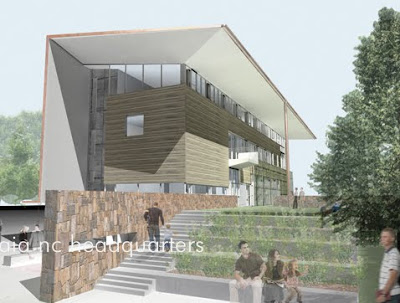
Ever since Frank Harmon won the competition for the AIANC Center for Architecture and Design in January 2008, not much had been made public about how the project was progressing. Even some of our sources close to the project seemed skeptical that the project would be built soon. Given the current state of the field and economy in general, it would have been understandable if the AIA had decided to put the project on hold. It might not have sent a positive message to its members, but understandable nevertheless.

Fortunately for us, that's not the case. Two weeks ago, in the annual Harwell Hamilton Harris Lecture, Frank Harmon showed images of the project (located on the corner of Peace and Wilmington at the end of Raleigh's government mall) after several years of design development with a large committee of designers. He went on to describe his "healthy urbanism" project in careful detail, including the original design concept, developments since the competition and a fairly thorough discussion of the building's intended purpose and sustainable features. He announced furthermore, that construction by Clancy & Theys should begin this May and that the building should be completed within 10 months.

We here at Raleigh Art, Architecture and Urbanism are excited to hear that this project is on track to be built so soon. More information has been released: a fairly thorough project booklet on AIA NC's website including plans, sections, materials, sustainable systems, salient diagrams, and cost estimates, and more information from WUNC's the State of Things (follow the link to listen to the audio) last Friday. Frank, Along with Scott Cutler of Clancy & Theys joined Laura Leslie to talk about the project's status.

We applaud AIA NC for pushing this project forward despite tough economic times, setting an example of responsible design not only in the Triangle or the State, but nationally as well. According to the audio North Carolina AIA will be the first chapter to design and construct their own building. If that's true, (we haven't had the chance to verify this so don't hold us to it), what does that say about the AIA itself? How could such a large professional body, which specializes in designing buildings, not have ever designed their own headquarters? This project has the opportunity to not only be a model for sustainable design, but also a center for outreach. All signs seem to point to the fact it will be a place for people to visit, hold activities and meetings, and most of all to open minds about the impact design has on our day to day lives and how truly important good design can be for our future.