This is old news (April 2009) but it doesn't seem like too many people realize that it happened. The house is featured again in the special awards section of this month's (Aug 2009) issue of Architectural Record.
Good write-up of the award announcement
Frank Harmon's project description
Thursday, July 23, 2009


Wednesday, July 22, 2009
Weber House and others up for Historic Landmark
Six potential historic landmarks will be considered by the Raleigh Historic Districts Commission and the City Council Tuesday August 4th at 7:00 pm. From the City's website:
A quick browse on the internet also produced The Weber House Landmark Application. This application is a very thorough look at the house, with some fantastic images not likely seen anywhere else except to those with access to the house. It's definitely worth a look.
We encourage you to learn more about these houses (search websites such as Triangle Modernist Houses and others), and attend the meeting and ensure the future of these important Raleigh houses.
The purpose of the public hearing is to solicit public comment on the historic landmark reports and proposed Raleigh Historic Landmark designations for the following properties:
- The Bill and Betty Weber House (1953), located at 606 Transylvania Avenue, is an example of Modernist style as designed by local architect William Weber in collaboration with Modernist master George Matsumoto. The structure was built during the postwar period of rapid economic expansion in Raleigh;
- The Dr. M.T. Pope House (1900), located at 511 S. Wilmington Street, illustrates the presence of a middle and professional class of African-American families along South Wilmington Street. A rare and early example of a front-gable structure of high-quality and stylish workmanship, the house is associated with Dr. M.T. Pope, an African-American physician, and his wife and daughters, each prominent and influential figures in North Carolina;
- The Lemuel and Julia Delany House (1917), located at 210-212 North State Street in the Idlewild subdivision, is significant for its role in Raleigh's African-American community in the early- and mid-twentieth century. The Classic Revival and Craftsman-style house is associated with physician and business leader Lemuel Thackara Delany and his wife, St. Augustine’s College instructor Julia Amaza (Brown) Delany;
- The Paul and Ellen Welles House (1956), located at 3227 Birnamwood Road, was designed by Durham architect Kenneth McCoy Scott and built by the Jim Edwards Company. A dramatic and intact example of the Modernist split-level, its design was influenced by the modern design theory taught by professors at North Carolina State University, School of Design;
- Saint James African Methodist Episcopal Church, (1923) is located at 520 Method Road in the Method neighborhood. The Gothic Revival brick church is an example of the stylish churches that anchored Raleigh’s African-American developed suburban communities from the end of the Civil War through the 1950s.; and,
- The Truman and Annie Laurie Williams House (1939), located at 910 Harvey Street, is a rare example of the Norman French style in Raleigh and was designed by Jerome Robert Cerny, a noted architect of residential estate homes in the Chicago area. The landscape was designed by Charles F. Gillette, one of the most prominent twentieth century landscape architects of the Southeast.
A quick browse on the internet also produced The Weber House Landmark Application. This application is a very thorough look at the house, with some fantastic images not likely seen anywhere else except to those with access to the house. It's definitely worth a look.
We encourage you to learn more about these houses (search websites such as Triangle Modernist Houses and others), and attend the meeting and ensure the future of these important Raleigh houses.
Thursday, July 16, 2009
Cassilhaus featured in NYT
While not directly dealing with Raleigh, we have to tip our hat to Durham-based architect Ellen Cassilly, whose personal residence was recently featured in the New York Times. Cassilhaus (a combination of Ellen's last name Cassilly and her husband's last name Konhaus) is a modern house beautifully sited on a slope overlooking a creek on the edge of Duke Forest. However, the most intriguing aspect of the house is the way that it integrates a studio for a visiting artist, an art gallery, as well as the couple's personal residence. The house excels at addressing and integrating with the site, attention to detail, imaginative programmatic thinking and several fantastic moments as one moves through the carefully planned spaces. We eouncurage you to visit the links above and learn more about Cassilhaus.
Monday, July 13, 2009
Bugg House Tour
Several weeks ago I attended a tour of the Bugg House over in Durham. The design is by Kenneth Hobgood Architects, and the construction is by Tonic (you will see Vinny in one of the images). The house responds to the site seamlessly, and will certainly be an impressive modern residence upon completion later this year. Thanks to the Young Architects Forum for organizing the tour.
 View from inside the living to the creek behind the house
 View from one of the wings into the central courtyard
 Living room featuring clerestory
 Screened porch for outdoor entertainment
Credit A. Cherry for the images.
View from inside the living to the creek behind the houseView from one of the wings into the central courtyardLiving room featuring clerestoryScreened porch for outdoor entertainmentSaturday, July 11, 2009
What could this be?
So I am heading downtown to Boylan Avenue and I happen upon this structure which is curiously all by itself in a field next to what appears to be an abandoned manufacturing facility.
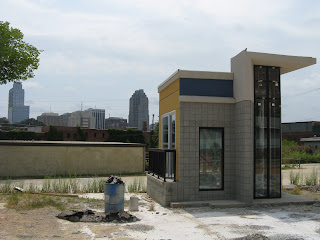

Curious as always, I stop for a minute to inspect what it might be. Truthfully, I had no idea. My first thought was that it could be some kind of installation. My wife suggested that it might have some sort of relation to the nearby train tracks, maybe a conductor's office for example. After a few minutes, we had no idea so we got back in the car and continued on our way.
A short time later, I'm driving, still thinking about what the structure may have been and I notice a building that seems oddly familiar. It's the new Hue Condominium project. But why does look so familiar? Then it hits me, the small structure that we saw a few blocks back must be some sort of trial run or teaching tool for the contractors who would be installing the exterior of the building. By using the same materials and detailing, a small detail (or a very large study model) was likely as practice before finishing the actual project.
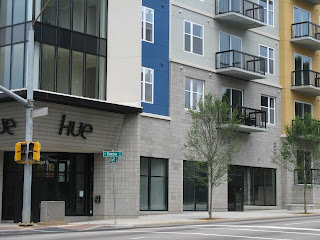
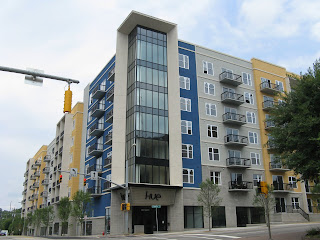
You'll notice the exact same materials and detailing used in both structures. The same color palette too. As for the project itself, I think the location is perfect for a mixed use building. The design is fairly interesting, but to me something seems to be lacking. However, I am all for the concept of urban living and mixed-use developments. Hopefully all the condos sell, but in my amateurish opinion, it seems like Raleigh's downtown is over-priced and over-built given the current housing market. I always want downtown developments to succeed to continue fueling the urban renaissance that taking place all across the country, of which downtown Raleigh is an excellent case study.
Tuesday, July 7, 2009
Obsessed with stairs?
For all those stair lovers out there here is a website to feed your obsession...
 and for those with a more casual interest, you might find something you like too. Completely unrelated to the Raleigh design scene I know, but this was just too good to pass up. A friend showed me this site the other day and I felt obliged to pass it on.
The stairs you see are my personal (most recent) favorites. They are by roedig.schop architekten of Berlin on their personal residence part of the Ten in One project.
Be on the lookout for upcoming articles about NCMA and The New American House Project.
and for those with a more casual interest, you might find something you like too. Completely unrelated to the Raleigh design scene I know, but this was just too good to pass up. A friend showed me this site the other day and I felt obliged to pass it on. The stairs you see are my personal (most recent) favorites. They are by roedig.schop architekten of Berlin on their personal residence part of the Ten in One project.
Be on the lookout for upcoming articles about NCMA and The New American House Project.
Friday, June 19, 2009
Preservation
How is it that we as a culture decide that certain buildings are worthy of preservation? Is it as simple as age or what is deemed to be some sort of "important" circumstances surrounding certain structures? It seems to be a fine line to walk. Where do we begin? If history itself is the primary criteria how can we sit idly by as many of our vernacular structures, such as the tobacco barns of my youth, fade forever from our landscape? If it is circumstance that becomes the main criteria, how is it that we decide which buildings are deserving? Who's history do we value and thus that of their buildings? Aside from the context of the southern plantation and their corresponding slave quarters we rarely see buildings that tie directly into the lives of African Americans. It must be assumed that many of these buildings were, more often than not, deemed to be less than important and therefore became easy targets for the wrecking ball (See Durham Freeway). It is important that we recognize our past transgressions and not allow what little that remains of various fragments of our culture to fall between the cracks (See Oberlin Village). Gone, hopefully, are the days when seemingly the only preservation that mattered was that of the extravagant homes of the wealthy and large public/corporate buildings. As Americans with comparatively so little tangible history, it seems as though we would be more all encompassing in our efforts.
I can not argue that all old buildings are worth saving, however I will always contend that future generations be afforded the opportunity to experience the many diverse aspects of our building culture and not just what is considered to be "important" today...
I can not argue that all old buildings are worth saving, however I will always contend that future generations be afforded the opportunity to experience the many diverse aspects of our building culture and not just what is considered to be "important" today...
Subscribe to:
Comments (Atom)

