Friday, December 18, 2009

Thoughts about another view of Raleigh's skyline

Several months ago (it's been far too long since we paid the blog the attention it deserves) we wrote about some of the best views of Raleigh's skyline, including views from the Boylan Bridge and from McDowell Street. While they are very different views, each offer insights into the past, as well as the future, of the City of Oaks.

I recently discovered another view, from the 9th floor of the DH Hill library on NCSU's campus. It provides an interesting perspective on the discussion. The first thing evident in this view, is the linear, north-south orientation of Raleigh's downtown. The north end is comprised primarily of government buildings (City, County and State), while the south end is more business interests, as well as some residential. Also quickly evident is the overall flat terrain, with some rolling hills so common to the Piedmont region.
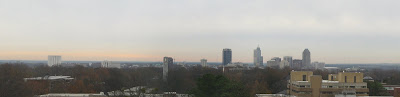


On the surface the image seems somewhat banal, with little information about Raleigh to share. For some reason, however the image kept returning to my mind. It felt like there was something there to discover, something to inform my understanding of the city. Going back to the image later in the day, my thoughts became somewhat more clear. Raleigh is not a city that was selected for its proximity to some predominant natural feature, such as a river or mountain. Nor is it a city that one thinks about as highly urbanized or dense. Yet in this image it appears to have a fairly urban core, with little visual evidence of urban sprawl.

The natural feature most prominent in Raleigh (clearly displayed in this image), is its densely-wooded nature, and subsequent tree canopy. The large population of Oak trees (for which the city receives its nickname, the City of Oaks), as well as other native species, provide a thick canopy over much of the city. This is true even in December, when most of the deciduous trees have shed their leaves. The canopy is so thick that it covers much of the lower density areas that prevail in Raleigh.

A trip up to the library wasn't necessary to glean this seemingly small observation, but maybe it caused me to think a little longer about the region as a whole (and the underlying disconnect between the various cities) than I otherwise would have. I began to think that maybe in this instance the lesson to be learned is less about what I do see, and more about what I don't see.

In the visually-biased and visually-dominated society that we live in, it makes sense to consider the role that visual connections play in our sense of belonging, especially to a particular area such as the triangle. For example, when entering the woods, one only needs to walk a short distance before a feeling of seclusion and isolation ensues, despite the short distance traveled. Maybe this lack of visual reciprocity is one small part of the explanation to why Raleigh struggles to claim its role as the capital city within the triangle, not to mention throughout the state. Or why people living outside the beltline describe going "downtown" like an all day event to some distant, foreign destination. Or why the region as a whole is often described as the triangle and rarely as the Raleigh metro area. Maybe this tells us something about how crucial the role of sight is in design of all sorts. Or, maybe it tells us nothing at all.

Thursday, November 5, 2009

Raleigh being Raleigh...

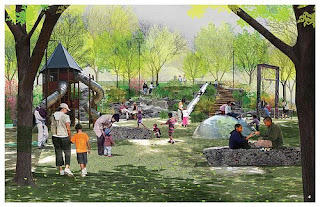
While I commend the City of Raleigh for holding the Moore Square re-design competition I have a hard time grasping exactly how the jury decided upon the winning submission. Recently I’ve spent quite a bit of time looking more in depth at many of the entrants and I have to wonder, am I missing something? I quite like the 3rd place entry by Stephen Stimson Associates (Falmouth, MA) as well as a number of the honorable mentions, specifically those done by Davin Hong, Tonic Design, and Lappas & Havener + Frank Harmon Architects and I fail to see how ANY of those could place behind what for all intents and purposes is a scheme that revolves around a manufactured "hill" along with extraordinarily cheap-looking playground equipment as two of it's primary design features. The images may have been "pretty" in the sense that they were well done technically, but the scheme overall feels like a space that could quite literally be ANYWHERE, USA. In addition, there's nothing remotely specific to the city of Raleigh or the surrounding site context within the scheme. All that was included in any of the renderings/plans was the square itself, with absolutely no mention, reference, or image reflecting the overall site. How could this happen? It must be said that while I personally know and highly respect more than a few members of the Jury, I find my faith in design, community design specifically, seriously shaken by this entire process. This competition was a golden opportunity for something extraordinary, not only for the City of Raleigh but for all of North Carolina as well. What we got could not have possibly been less exciting and I’m more than a little embarrassed for it. All in all, I guess its just business as usual and Raleigh just being Raleigh....


Friday, October 30, 2009

Monica Ponce de Leon lecture NEXT Monday (7PM, Nov 9)

Next Monday night (Nov 9) there will be a fantastic, open to the public, lecture at NCSU's Burns Auditorium at 7 pm. Monica Ponce De Leon will be speaking about her work with Office DA (as co-founder and principal) and possibly some of her efforts as the new dean at the Taubman College of Architecture and Urban Design at the University of Michigan. Office DA does great work and we've heard that her lectures are not to be missed. Be there early if you want to get a good seat, it should be packed.

Monday, October 12, 2009

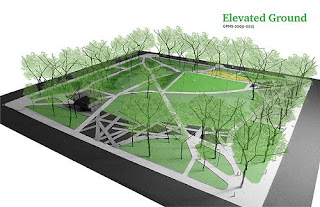
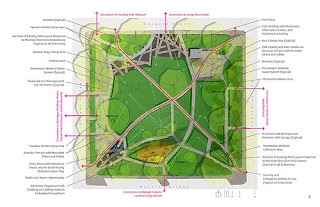
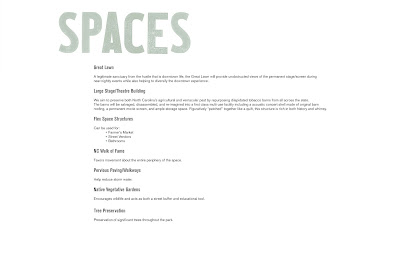
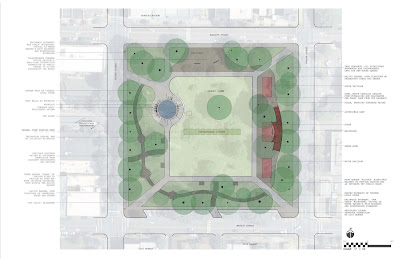
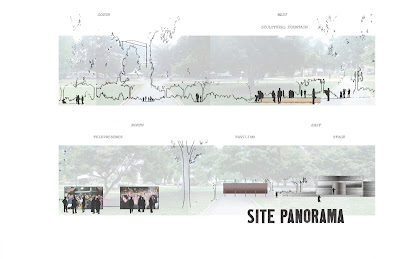
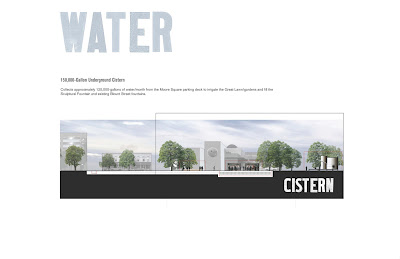
We're Back!!!! Our Moore Square Competition Entry

Below are the images from the North Carolina Design CoOperative (NCDC) Moore Square entry. Although we got a good response, we unfortunately did not place. Everything's being kept pretty under wraps about the winners but it has come to our attention that both Kling Stubbins and Tonic Design (along with David Hill) received Honorable Mentions, congratulations to those guys. We'll have more on the competition/process later.


Tuesday, September 22, 2009

Blog Status Update

For the past month or so Raleigh AAU has had to be set aside due to a variety of reasons. We will be finishing up our Moore Square entry this week and we hope to be back to the blog full force come October. After submissions are closed and the reviews take place we will be posting our entry to the blog as well as a lengthy article on the entire process. Also in the works is an article on the Szostak Design "New American House" project, which located in Raleigh and set to break ground within the next few months. We are very sorry for the lack of recent activity but we're excited about the future. See you soon....

Monday, September 7, 2009

N & O Home of the Month

The News and Observer's August edition of the "Home of the Month" was just recently released. The "Home of the Month" is a collaborative initiative between N & O, and NCSU's College of Design, specifically through the Home Environments Design Initiative (HEDI). This month's article is written by current NCSU graduate student Virginia Alexander.

Transplanted Glory

Sunday, August 30, 2009

Catalano House to be Rebuilt

I was pleasantly surprised to hear, from a number of reliable sources, that the Eduardo Catalano house looks like it will FINALLY be re-built. The site is situated on a small plot of land close to Dorthea Dix which is currently owned by NCSU. This is the latest in the long line of attempts to rebuild the iconic/revolutionary mid-century house, with the others failing due to various reasons including, but not limited to; serious project mismanagement by the previous NCSU administration, the simple mindedness of a few misinformed students, and the selfishness of the NC Art Museum officials. With the possible exception of Dorton arena, the Catalano house is the finest example of architectural innovation to ever be seen in North Carolina. Hopefully this reconstruction attempt will fair better than those of the past.


Profile on Eduardo Catalano